
Different Paths in SEO: Black Hat and White Hat | Search engine optimization, or SEO, is one of the most important strategies for improving a website’s visibility in search results. Businesses, bloggers, and online publishers use SEO to attract organic traffic, reach potential customers, and build a long-term digital presence.
However, not every SEO strategy follows the same philosophy.
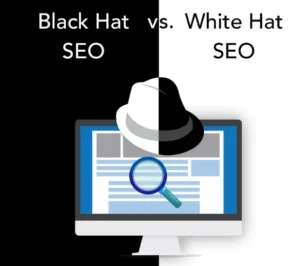
Two commonly discussed approaches are Black Hat SEO and White Hat SEO. They represent very different ways of trying to improve search visibility. White Hat SEO focuses on creating value for users and following search engine guidelines, while Black Hat SEO relies on manipulative techniques designed to influence rankings.
Understanding the difference can help website owners choose strategies that are sustainable and less likely to create serious problems in the future.
What Is White Hat SEO?
White Hat SEO refers to optimization practices that generally follow search engine guidelines and prioritize users.
The goal is not simply to manipulate rankings. Instead, websites improve their content, structure, usability, and authority so that search engines have legitimate reasons to rank them.
Common White Hat SEO practices include:
- Creating useful, original content
- Researching relevant search queries
- Improving website speed and usability
- Optimizing page titles and headings
- Building logical internal links
- Earning high-quality backlinks
- Improving mobile accessibility
- Providing accurate and helpful information
White Hat SEO usually requires patience, but it can create a stronger foundation for long-term organic growth.
What Is Black Hat SEO?
Black Hat SEO describes techniques that attempt to manipulate search rankings in ways that violate or circumvent search engine guidelines.
The objective is often to achieve faster results by exploiting weaknesses in ranking systems rather than improving the experience for users.
Examples can include:
- Keyword stuffing
- Cloaking
- Hidden text
- Manipulative link schemes
- Automatically generated low-quality content
- Doorway pages
- Misleading redirects
Search engines continuously update their systems to identify and reduce the impact of manipulative practices.
Google’s Search Essentials provide guidance on technical requirements, spam policies, and best practices for websites seeking visibility in Google Search.
White Hat vs. Black Hat SEO
The easiest way to understand the difference is to look at the intention behind the strategy.
| White Hat SEO | Black Hat SEO |
|---|---|
| Focuses on users | Focuses primarily on rankings |
| Follows search engine guidelines | Violates or attempts to circumvent guidelines |
| Builds long-term value | Often seeks quick results |
| Uses relevant, useful content | May use manipulative or low-quality content |
| Earns authority naturally | May manipulate links or other signals |
| Generally more sustainable | Higher risk of penalties or ranking losses |
The distinction is not always about a single tactic. Context and implementation matter.
For example, using keywords is a normal part of SEO. Repeating the same keyword unnaturally throughout a page simply to manipulate rankings can become keyword stuffing.
Keyword Stuffing: When Optimization Goes Too Far
Keywords help search engines understand what a page is about.
However, repeatedly inserting the same phrase into a page can make content difficult to read and may be considered spammy.
For example, a sentence such as:
“Best shoes are the best shoes because our best shoes are the best shoes for buying the best shoes.”
is clearly written for search engines rather than humans.
A better approach is to use natural language and related terms while answering the user’s actual question.
Modern SEO is less about repeating a keyword and more about demonstrating relevance and usefulness.
Link Building: Quality Over Quantity
Backlinks can be valuable because they can help search engines understand the authority and relevance of a website.
However, buying or creating large numbers of manipulative links can create problems.
White Hat link building focuses on earning references through useful content, legitimate partnerships, digital PR, research, resources, or other genuine reasons for another website to link to a page.
Black Hat approaches may attempt to manufacture artificial authority through link schemes.
The difference is simple:
White Hat: earn links because the content deserves them.
Black Hat: create or manipulate links primarily to influence rankings.
Content Quality Matters
Content is one of the most important areas where White Hat and Black Hat approaches can diverge.
A White Hat strategy focuses on answering the user’s question clearly and accurately.
A Black Hat strategy may prioritize producing large amounts of content simply to capture search traffic, even when the content provides little value.
Google’s documentation emphasizes creating helpful, reliable, people-first content rather than producing content primarily for search engine rankings.
This means website owners should ask:
Would this page still be useful if search engines did not exist?
If the answer is yes, the content is more likely to have genuine value.
The Risk of Black Hat SEO
The biggest attraction of Black Hat SEO is speed.
Manipulative techniques can sometimes produce rapid ranking improvements, particularly when they exploit weaknesses in search algorithms.
But those gains can be unstable.
Search engines may detect the behavior, algorithmic systems may reduce its effectiveness, or a manual action may affect a website’s visibility.
Google explains that manual actions can be applied when a website violates spam policies, potentially affecting how pages appear in Search.
For a business that depends heavily on organic traffic, losing search visibility can be extremely expensive.
Is Black Hat SEO Ever Worth the Risk?
For most legitimate businesses and long-term websites, Black Hat SEO is difficult to justify.
A temporary ranking increase is not necessarily valuable if it results in lost traffic later.
Imagine a business spends years building a website and developing organic visibility. If aggressive tactics cause the site to lose rankings, recovering that visibility can take significant time and resources.
This is why sustainable SEO generally focuses on strategies that remain useful even as search algorithms evolve.
Why White Hat SEO Takes Longer
White Hat SEO can feel slow because it requires real work.
A website may need to:
- Research its audience.
- Create useful content.
- Improve technical performance.
- Earn relevant links.
- Build topical authority.
- Improve user experience.
- Analyze performance.
- Update content over time.
There is no guarantee that every page will rank quickly.
However, the work creates assets that can continue generating value.
A well-written article can attract visitors for years. A useful research report can earn natural backlinks. A technically strong website can provide a better experience across many pages.
Gray Hat SEO: The Middle Ground
Between Black Hat and White Hat SEO is what marketers sometimes call Gray Hat SEO.
Gray Hat techniques may not clearly violate a specific rule but can involve strategies designed primarily to influence search rankings rather than improve user value.
This category can be difficult to define because search engine guidelines change and different tactics carry different levels of risk.
For businesses, the safest approach is to prioritize strategies that clearly improve the website for users.
The Role of AI in Modern SEO
Artificial intelligence has introduced new opportunities and challenges for SEO.
AI can help marketers with tasks such as:
- Brainstorming topics
- Organizing research
- Creating content outlines
- Analyzing search intent
- Improving readability
- Identifying content gaps
However, automatically generating large volumes of low-value pages simply to attract search traffic can create quality problems.
AI should ideally support human expertise and editorial judgment rather than become a shortcut for publishing large amounts of generic content.
The goal remains the same: create useful information for real people.
How to Choose the Right SEO Strategy
For most websites, the best approach is to build an SEO strategy around long-term value.
Start by understanding what your audience needs. Then create content that genuinely answers those needs.
Next, make sure search engines can access and understand your website. Improve technical performance, organize your content logically, and develop legitimate authority.
A practical strategy might look like this:
Research → Create useful content → Optimize naturally → Improve user experience → Earn authority → Measure → Update
This process may take longer than aggressive ranking tactics, but it provides a much stronger foundation.
Black Hat and White Hat SEO represent two very different paths to search visibility.
Black Hat SEO attempts to manipulate search systems through techniques that can violate guidelines or create significant ranking risks. White Hat SEO focuses on users, quality, relevance, and sustainable growth.
For a website intended to survive and grow over the long term, White Hat SEO is generally the safer and more valuable approach.
Search algorithms will continue to change. Specific ranking factors may evolve, and new technologies will reshape how people search for information. But one principle remains reliable:
Create something genuinely useful, make it accessible to search engines, and give people a good reason to trust your website.
That is the foundation of sustainable SEO.